



“Ain’t Winning Sh*t”: Stephen A. Smith Warns Lakers After Austin Reaves Extension Casts Doubt on LeBron James’ Future
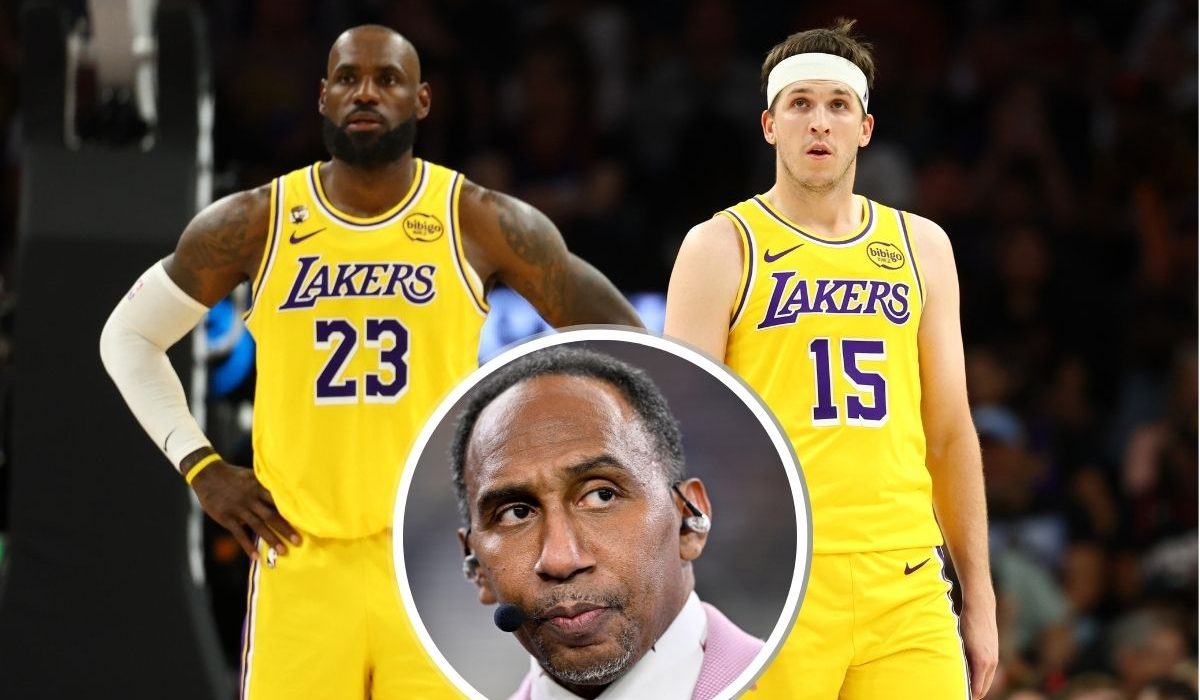
For nearly a quarter of a century, betting against LeBron James has rarely ended well. Even at 41, he continues to shoulder championship dreams, while amplifying his longevity. Now, amid his impending off-season decision, the Lakers made their first major move this summer. Suddenly, questions surrounding Bron’s future have intensified.
Watch What’s Trending Now!
The LA side has rewarded Austin Reaves with a 4-year, $185 million max extension, while their superstar forward remains unsigned. With chatter about the probable James trade already looming in rumor city, the extension only pushed it further. And the sequence prompted a Stephen A. Smith intervention. Speaking on The Stephen A. Smith Show, the veteran analyst was left to wonder whether the legacy franchise had lost its sight.
“Lakers ain’t winning sh*t. Just gonna get that out of the way right now. We’re gonna start up this show by keeping it a buck. They ain’t winning a damn thing. OK?” Smith said. “Unless they keep LeBron James.”
However, Smith didn’t divert the frustration toward Austin Reaves. Although many criticized the deal, highlighting AR’s lack of All-Star and All-NBA selections, Smith found it deserving. He argued that the 27-year-old deserved every bit of the new deal, solely because of his development into one of the most dependable offensive options.
“He’s earned it. He deserves it. I mean, there was a time this year when he was averaging damn near 30,” SAS said. “Averaging damn near 30 because that’s what he brings to the table. That’s how he matters.”
Despite a career-low 51-game appearance, the 2025-26 season was indeed a defining year for AR. He produced a career-best 23.3 ppg. Most importantly, he demonstrated elite scoring early in the season, averaging 32.0 ppg in October and 26.9 ppg in November.
Nevertheless, paying Reaves what he deserves doesn’t solve the Lakers’ concern, according to Smith. He acknowledged that the backcourt duo, Luka Doncic and AR, can score against anyone. But at the same time, he questioned whether the pair could win a ring for the franchise.
“They can score on anybody. We know that. They can’t stop a cold. They can’t stop a cold. And the only way this works is if you find a way to keep LeBron James,” Smith said. “Mr. 41 years of age, approaching 42, approaching his 24th season in the NBA, still one of the greatest players in the world. Let’s stop acting like we don’t know.”
Even in his 23rd season, moving away from a primary offensive role, the superstar averaged 20.9 ppg, 7.2 apg, and 6.1 rpg in 60 games. Yet when the injuries forced the team to lean on him, James showed up, reminding everyone that he’s a dependable star. Bron anchored the team in its first-round victory over the physically dominant Rockets.
“Who the hell was available in the playoffs? That was LeBron James. There were some games that Austin Reeves missed. Luka Doncic missed the entire playoffs. He’s 14 years younger than LeBron. Didn’t matter. LeBron James stays ready. Other people use the season to get ready. That’s why they’re not as reliable as he is.”
Smith also reminded viewers that despite the Lakers holding James’ Bird Rights, the 4x Champion remains an unrestricted free agent and can sign with any team he wishes.
“You’d better find a way to keep LeBron James. Because if you don’t, yeah, you got Luka. Yeah, you got Austin Reeves. You ain’t going nowhere.”
While Stephen A. Smith has put forward a valid argument, it also naturally raises an important question. After committing $185 million to Reaves with an annual salary of $46 million, can they still afford LeBron James while building the necessary supporting cast around him?
Can the Lakers still afford to keep LeBron James?
The answer is comfortably yes, but only under the right circumstances.
According to NBA insider Jake Fischer, LeBron James won’t consider a veteran minimum contract, which would pay him $3.8 million. So, the realistic path for the Lakers to bring him back is to offer a significant deal. The team has two choices.
- Offer him a maximum contract
- Convince him to accept a team-friendly discount that preserves financial flexibility.
Fortunately, Reaves’ extension doesn’t immediately complicate the Lakers’ plans. Although AR agreed to a 4-year, $185 million deal, his new salary will not count against the cap until the Lakers officially use his Bird Rights later in the off-season. Until then, Reaves carries only a cap.
This will allow GM Rob Pelinka to use the team’s available cap room before finalizing the extension, as per Yossi Gozlan, a cap analyst.
ESPN’s Brian Windhorst cut through a popular misconception on this point directly:
“Austin Reaves signing this contract does not affect the Lakers’ salary cap. They can still spend the exact same amount of money they could before, even though he signed a max.”
But Windhorst was equally clear about where the real tension lives- not in Reaves’ deal, but in James’.
“Every dollar that LeBron signs for is one less dollar that the Lakers can give another free agent. And that right there is why NBA teams have 10-person strategy ‘capology’ departments.”
That framing matters. The Reaves extension is cap-neutral in isolation for now. The stress test is LeBron- and specifically, whether he accepts a number that gives Pelinka room to build around him.
The bigger challenge comes with James’ impending contract. If he insists on a projected maximum salary that hovers around $50 million annually, the Lakers would breach the luxury tax territory. It will leave the team with a minimum of $15 million in the non-taxpayer MLE to build the supporting cast.
This is precisely where Windhorst’s second-order thinking becomes essential. He noted that pairing Reaves and Luka Doncic in the backcourt, a combination he called “a powerhouse” capable of scoring “a ton of points,” creates its own roster-building burden:
“If you have those two guys as your backcourt making a hundred million dollars a year… you’ve got to have a back line to help them. You got to have a rim-protecting center, and you’ve got to have wings that can defend, and that’s expensive.”
In other words, the Lakers aren’t just managing LeBron’s contract in a vacuum. They’re managing it against a roster architecture that already demands high-end, expensive role players at premium positions.
Meanwhile, a salary compromise would provide significant cap space to build the team. ESPN’s Bobby Marks echoed that Reaves’ extension does not reduce the team’s immediate flexibility because the Lakers can complete other moves before signing the deal.
The number Toporek identifies aligns almost exactly with what Windhorst is implying: a LeBron salary in the $30–35 million range would free Pelinka to chase a legitimate rim protector and perimeter defenders- the “back line” Windhorst says is non-negotiable.
Without that supporting cast, even a Doncic–Reaves backcourt has a ceiling in the playoffs, where defensive deficiencies are ruthlessly exposed.
“Will he accept that? Does LeBron understand [and] agree with the concept that Austin’s money doesn’t affect his money?”
It is a psychological question as much as a financial one.
The Lakers can afford LeBron. The question is whether LeBron’s price leaves them able to afford the team around him.