



The best and worst landing spot for every star on Robert Murray’s trade big board
The MLB lockout looms as an almost foregone conclusion on Dec. 1. In the meantime, it’s still business as usual for front offices hoping to improve their team, either through free agency or — more likely, given a relatively down class this year — through trades.
FanSided’s MLB insider Robert Murray recently outlined six big-name trade candidates who could end up on the move before the long winter begins. Let’s highlight the best and worst realistic landing spots for each player.
LHP Reid Detmers, Los Angeles Angels
Best landing spot: Chicago White Sox
Chicago’s epic collapse in the ALDS will lead to significant skepticism about this team’s future — a lot of “one-hit wonder” talk — but the White Sox are worth believing in. The lineup is stacked with ascending players who all compete hard and, better yet, compete for each other. A good clubhouse can go a long way. No team generates more positive vibes than these White Sox; there’s a real sense of unity in both personalities and purpose.
The White Sox desperately need to improve their rotation in order to take the next step. Reid Detmers fits the timeline at 27 years old, and he’s under club control through 2028. If Hagen Smith and Noah Schultz can ramp up as starters, suddenly the South Siders feel like a much more complete team. Plus, a trade like this proves the front office is serious about winning.
Worst landing spot: Philadelphia Phillies
Detmers would help any team. He’s one of the most underrated aces in MLB, with a 3.36 ERA and 4.9 fWAR this past season. The Phillies need more rotation depth, and Dave Dombrowski is great at unearthing aces on the precipice of a breakout. That said, Philadelphia already has three Cy Young-caliber arms in Zack Wheeler, Cristopher Sánchez and Jesús Luzardo, plus Andrew Painter and Aaron Nola. The Phillies need depth, but not necessarily another frontline ace. The cost of a Detmers trade would be prohibitive for a team with a bleak future and far more pressing needs on the positional front.
SS Zach Neto, Los Angeles Angels
Best landing spot: Atlanta Braves
The Braves need to find a long-term solution at shortstop and Zach Neto is as good a candidate as any. He’d add more right-handed thump and speed near the top of the lineup, with a .766 OPS on top of 27 home runs and 24 stolen bases this past season. The glovework is subpar and Neto is prone to the occasional strikeout binge, but he is also 25 years old with another three years of club control. He’s somebody the Braves can develop further, in hopes of unlocking a superstar ceiling.
Worst landing spot: New York Yankees
New York has myriad problems on the infield. On paper, the idea of adding Neto’s raw production to the American League’s most potent lineup is a compelling one. He can help replace the production lost with Jazz Chisholm’s impending free agency departure, while Ryan MacMahon has proven himself anything but an everyday player on the left side of the infield.
That said, the Yankees are so lax with their fundamentals. Neto is already a borderline disastrous defender at shortstop. Moving him to third base could mitigate some issues, but it’s hard to count on any real skill development given New York’s track record on that front. He’d be better off in a clubhouse with real accountability and a more detail-oriented approach.
INF CJ Abrams, Washington Nationals
Best landing spot: Los Angeles Dodgers
The Dodgers will be looking for a path back to the World Series. The front office has spent enough money for the next several decades, but L.A. also has a deep farm system, to the point where not every elite prospect has a path to the Majors. Cashing in on that excess capital to acquire an instant-impact infielder like Abrams, who’s still under club control for two more years, qualifies as a smart investment.
Los Angeles can bump either Abrams or Mookie Betts to second base, depending on which alignment works better on the field (or in the clubhouse). Suddenly, Abrams would find himself protected by star power on all sides in the lineup, with great mentors to learn from, in an organization laced with championship DNA.
Worst landing spot: Pittsburgh Pirates
Not unlike the Yankees with Neto, the Pirates‘ lack of fundamental soundness would scare me with Abrams. He’s not a good defender, to the point where Washington willingly dampened his trade value with a late-season move from shortstop to second base.
The Pirates replacing the outgoing Brandon Lowe with a younger, more athletic and even more productive alternative checks out — and Pittsburgh’s lineup would be fearsome, no doubt — but Abrams creates unwanted complications in the field. He’s also never going to get the extension he wants from Pittsburgh’s front office, so it becomes a tenuous short-term arrangement for a team that has yet to prove its mettle as a postseason contender.
OF Steven Kwan, Cleveland Guardians
Best landing spot: Chicago Cubs
The Cubs can just double down on a strength with Steven Kwan. An outfield with Kwan and Pete Crow-Armstrong immediately becomes the best defensive outfield in MLB, bar none — behind the best defensive infield in baseball, bar none.
The Cubs would preferably retain Seiya Suzuki or add another power bat, but run production was not an issue for Chicago last season. It was their abysmal pitching staff, which should improve by virtue of better injury luck and an increasingly desperate Jed Hoyer. In the meantime, Kwan can work counts, run the bases and help drive in runs with his extraordinarily refined plate approach.
Worst landing spot: Philadelphia Phillies
The Phillies could use a bit of Kwan’s competitive DNA. He’s a smart, calculated hitter and a brilliant outfield defender. Philadelphia needs guys who won’t get swing-happy under pressure or bleed runs with their glove. That said, the Luis Arráez experiment didn’t really move the needle as much as Philadelphia would have liked; Kwan fits a very similar profile. There’s also the Justin Crawford of it all. The Phillies need more power in the back half of the lineup, as much as anything.
SS Jeremy Peña, Houston Astros
Best landing spot: Atlanta Braves
Again, the Braves need a shortstop. Jeremy Peña’s contract situation complicates the situation, as Houston will demand an arm and a leg. The Braves and Peña’s famously stingy agent, Scott Boras, are not exactly aligned in their team-building ethos either. Still, Atlanta should embrace the all-in mindset. Peña is still in the prime of his career. He’s a legitimate 20-20 threat with a sound defensive reputation. The difference between him and Ha-Seong Kim would be night and day.
Worst landing spot: Boston Red Sox
The Red Sox were in the market for a shortstop up through last season’s trade deadline, but the front office addressed other positions instead. Curtis Mead was brought in to play second base, while Adley Rutschman is their new franchise catcher. Trevor Story’s contract is prohibitive, too, but more importantly, Boston has top-five MLB prospect Franklin Arias coming up behind him. That should settle the shortstop issue without a trade.
Peña is already stuck in a crowded infield with the Astros. If Boston empties out even more prospect capital, only to squeeze Peña into the frame with Mead, Story, Arias and Caleb Durbin, that would feel like a misallocation of resources.
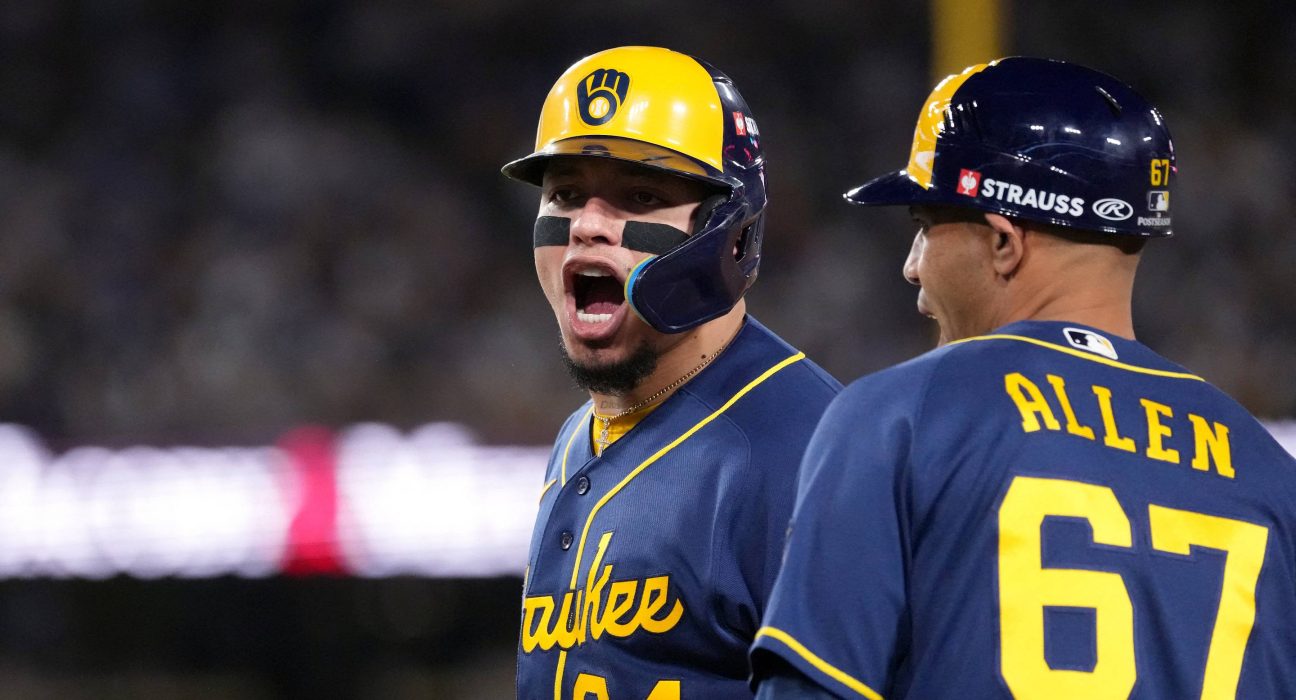
C William Contreras, Milwaukee Brewers
Best landing spot: New York Yankees
“Duh,” they all said at once. Robert Murray already linked Contreras to New York — the same team that was mentioned frequently in conversations around Adley Rutschman, Hunter Goodman and Ryan Jeffers at the trade deadline. Austin Wells was a horror show at the plate last season and New York lacks viable alternatives at catcher. Contreras will be an expiring contract, but the Yankees are lucrative enough to eventually extend him. Plus, there’s a good chance Wells is less disastrous in a platoon role.
Contreras brings a certain I.Q. and competitive fire that these Yankees would really benefit from, too.
Worst landing spot: Cincinnati Reds
Tyler Stephenson is a free agent and the Reds tried (but failed) to add an impact bat last offseason. The Brewers probably aren’t keen to trade Contreras in the division, but then again, is Milwaukee really scared of the Reds? Probably not. There’s a good reason for that. Cincy has the talent to put a contending product on the field next season, while Contreras provides real entertainment value beside Elly De La Cruz.
At the end of the day, however, Cincy should be weary of getting punked by a smart Brewers front office. The last thing the Reds want is to re-trade Contreras for less value at the deadline, or find his one season with the team cut short. Contreras, almost certainly, is not signing a second contract in Cincinnati.
 Add us as a preferred source on Google